"Which one fits my car?"
The same part name can cover dozens of variations. Without the exact engine, a customer is guessing, and wrong parts come back as returns.

AI parts assistant · built by Sagiam
A customer describes what their car is doing. Pablo asks for the vehicle and engine, checks your catalogue for parts that fit, shows what is in stock at their store and puts it in the cart. Your counter staff take over when a person is needed.
Why we built it
They start with a noise, a warning light or a car that won't start. At the counter, an experienced person turns that into the right part. Online, the same customer usually gets a search box and a list of 40 brake pads.
The same part name can cover dozens of variations. Without the exact engine, a customer is guessing, and wrong parts come back as returns.
DIY customers work on their cars in the evening and at weekends. That is when the phones are off and nobody is at the counter.
Every "is this the right one?" call takes time from staff who are also picking orders and serving trade customers in the store.
The conversation, step by step
Pablo follows the same questions a good counter person asks, in the same order, and checks the answers against your own data.
See it working
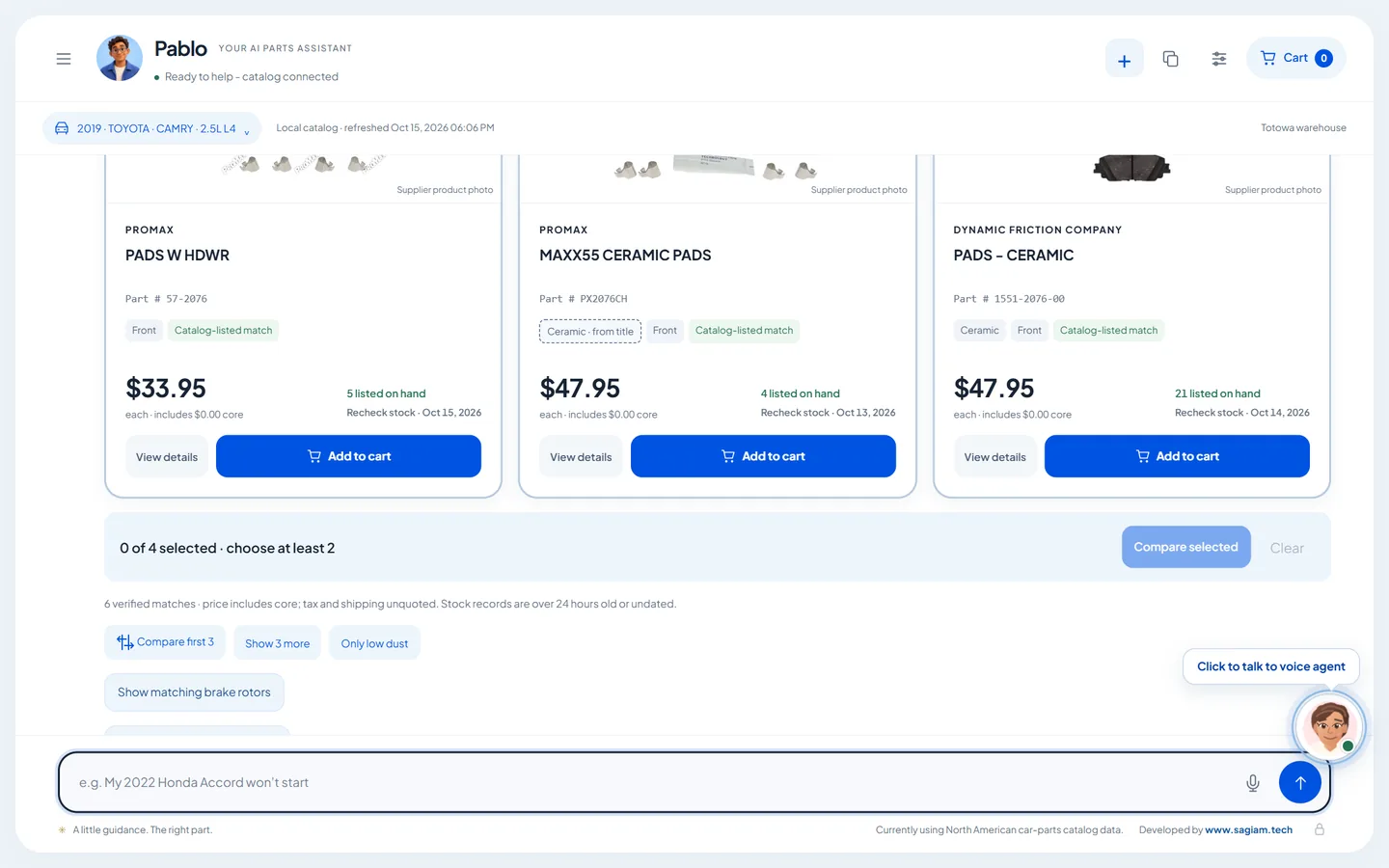
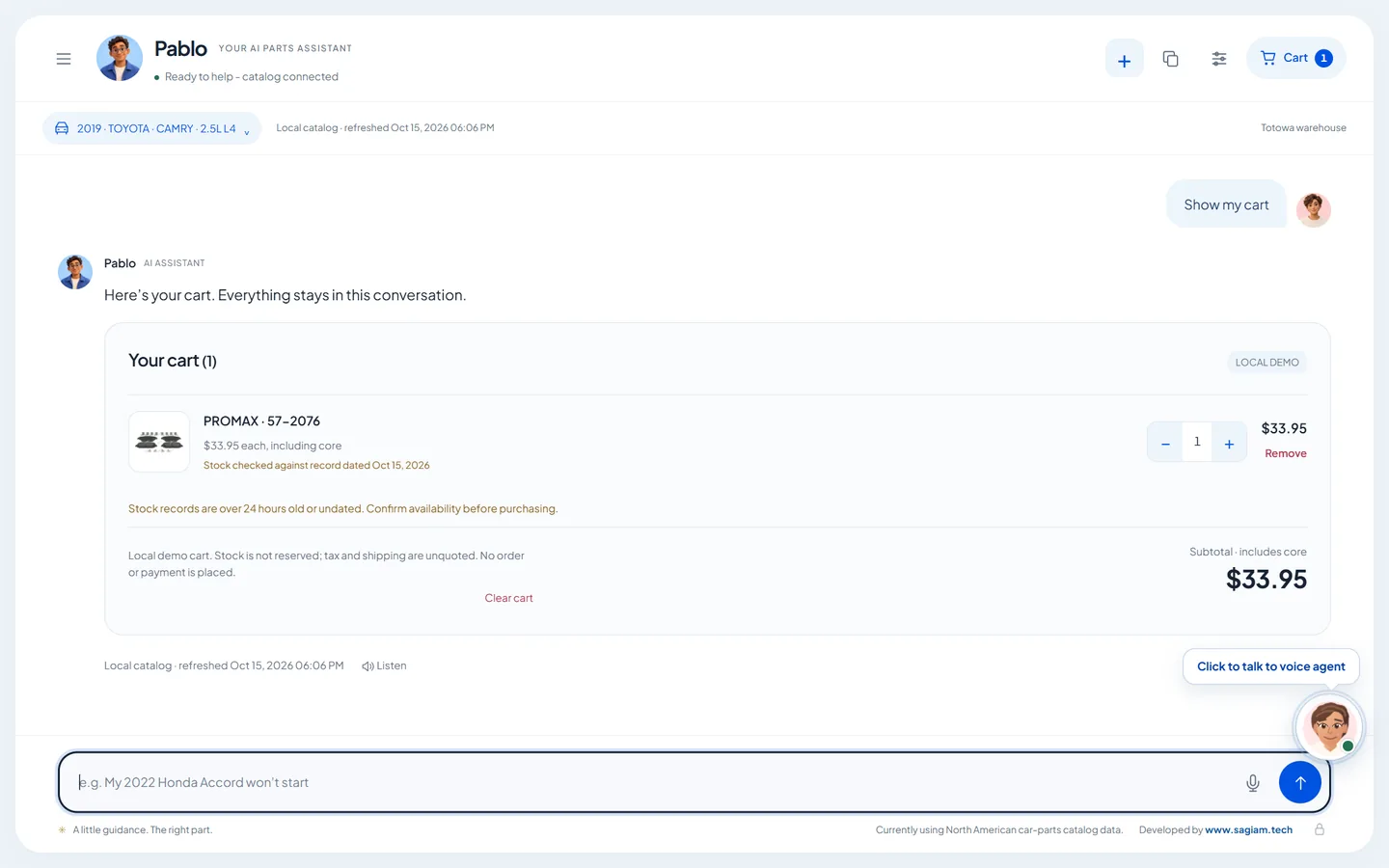
These screenshots were taken from Pablo running against a North American parts catalogue. The vehicle and question are a sample; the answers are what Pablo actually returned.
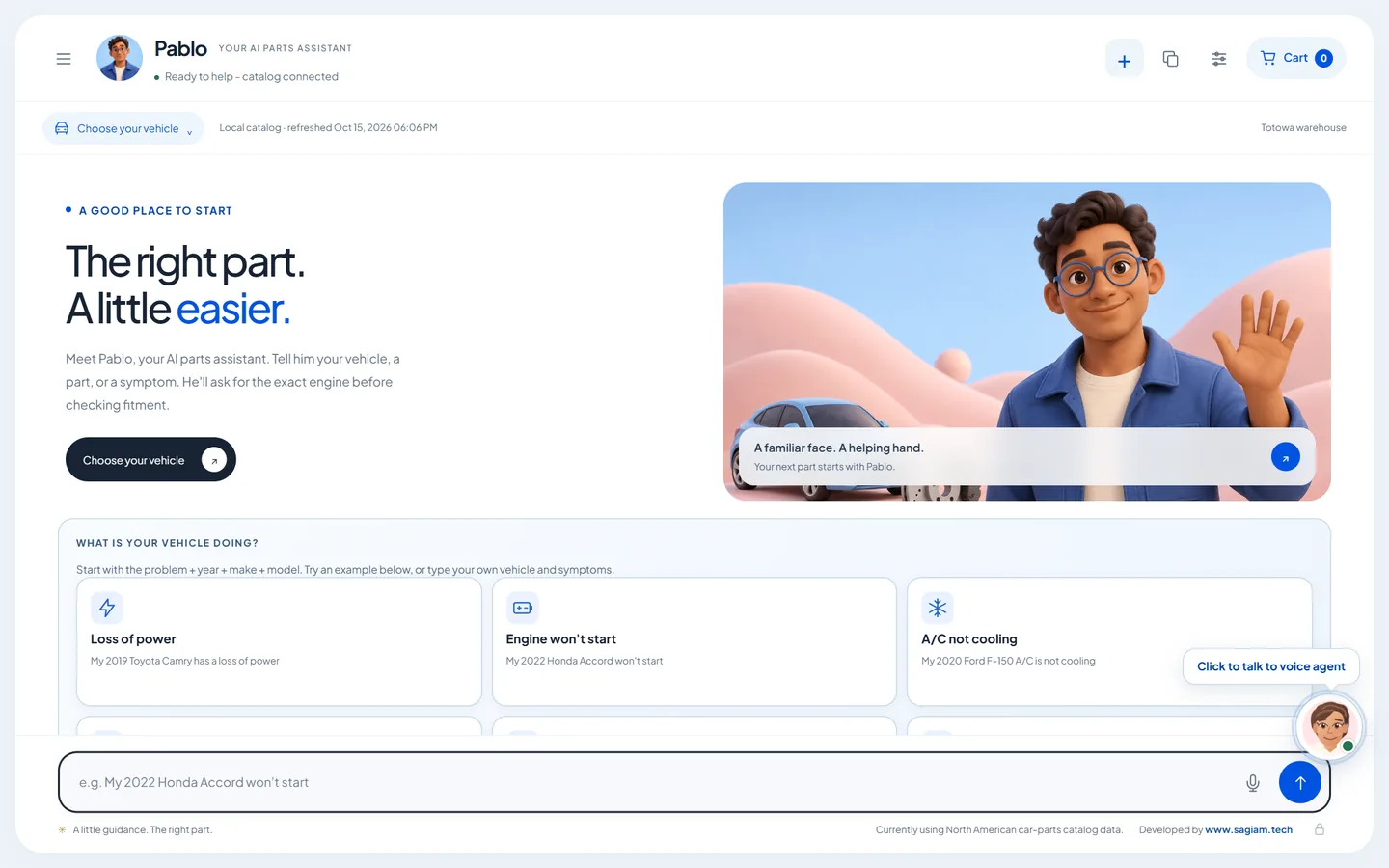
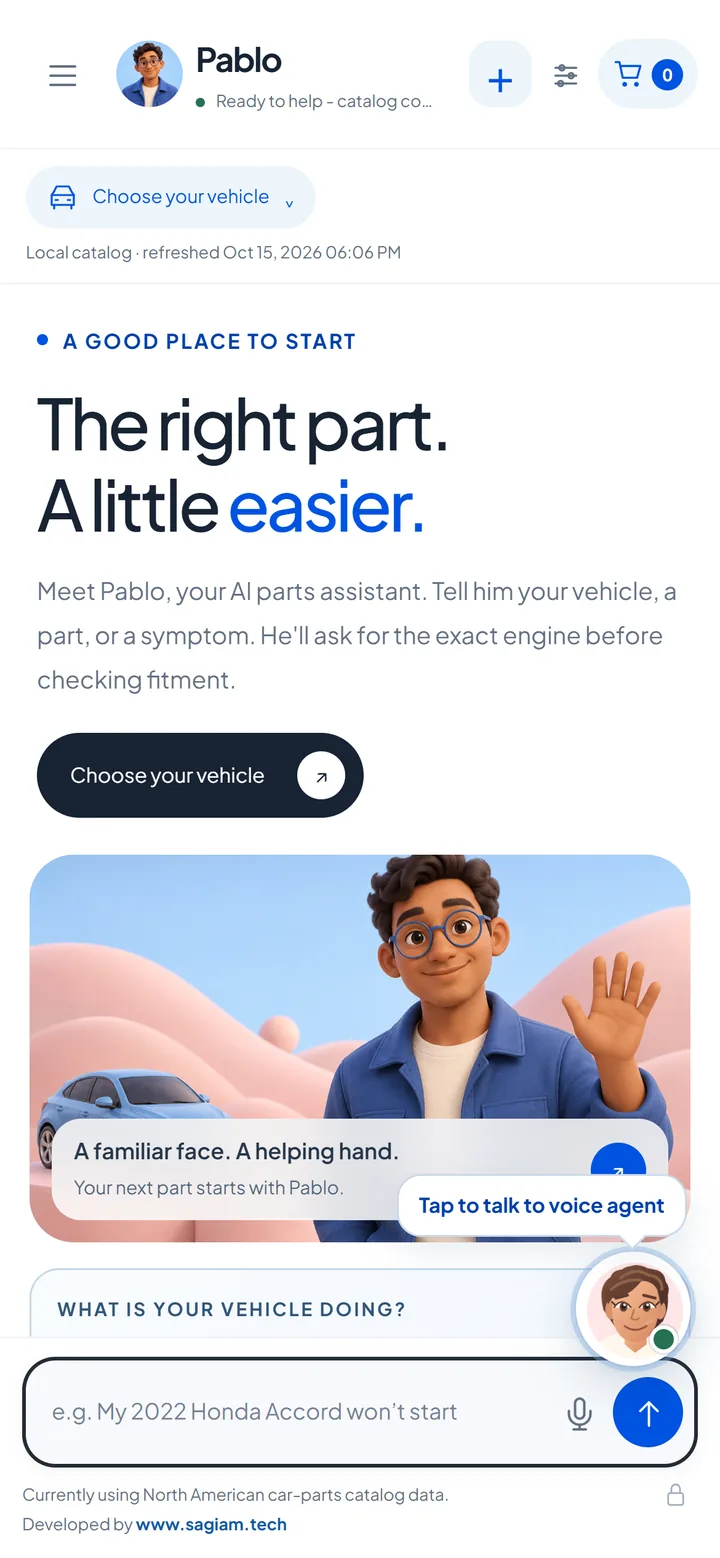
01 · Start anywhere
Customers can pick their vehicle, ask for a part by name or simply describe what is wrong. Common problems are one tap away, so nobody has to know the right words.
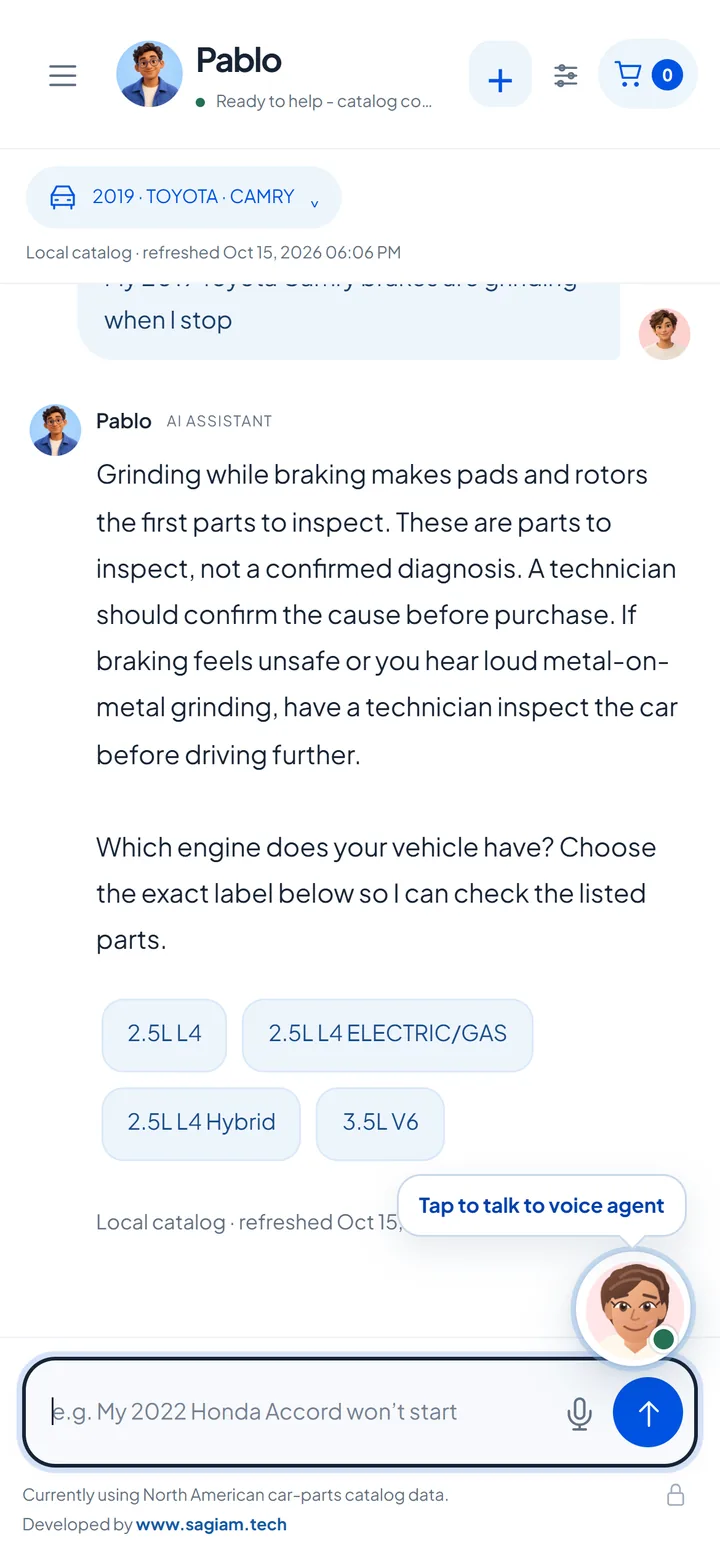
02 · Ask before guessing
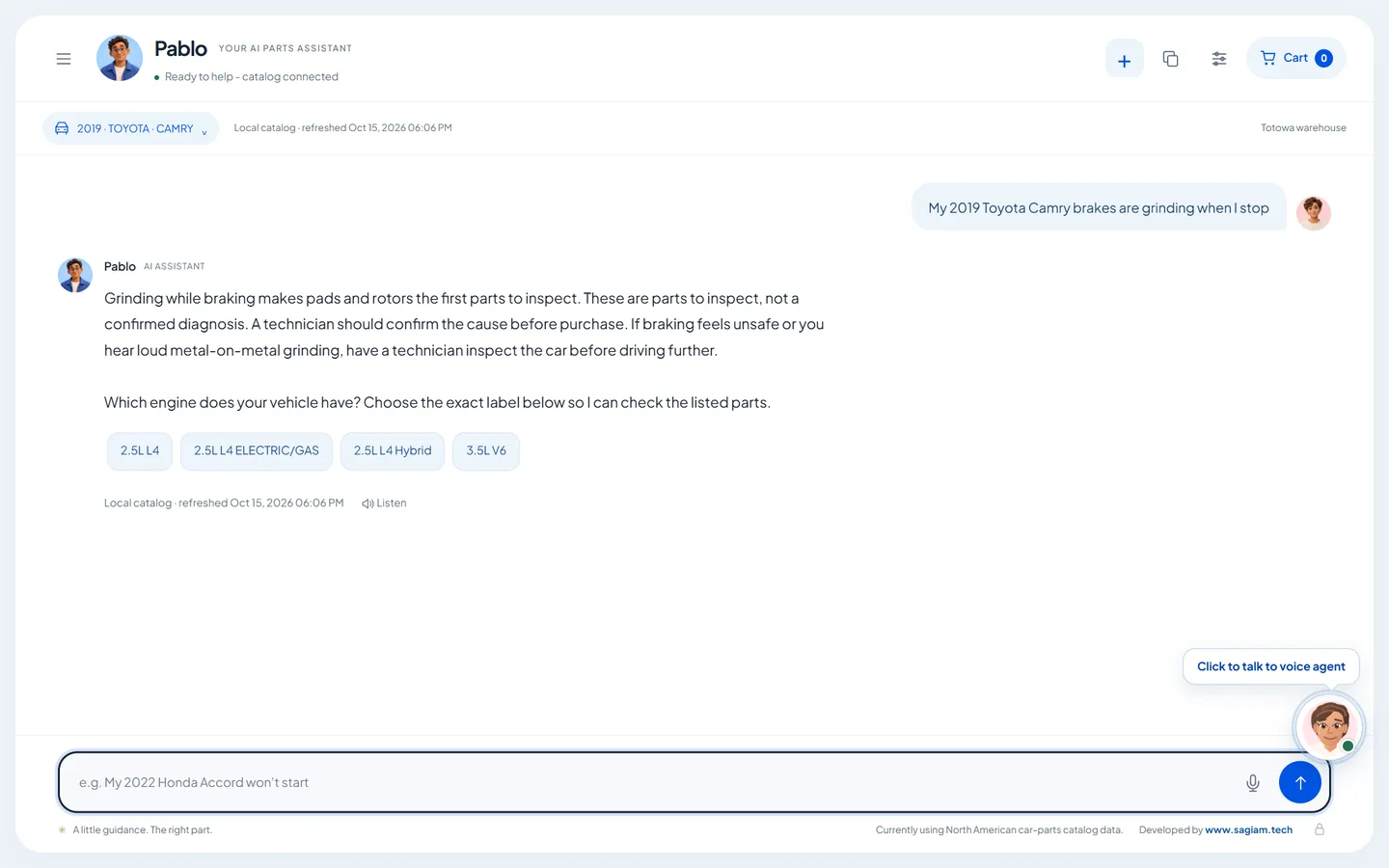
A 2019 Camry was sold with four engine options. Pablo won't suggest a part until it knows which one, then it asks whether the problem is at the front or the rear.
"These are parts to inspect, not a confirmed diagnosis. A technician should confirm the cause before purchase."
On the phone in the garage
Most people asking about parts are standing next to the car. Pablo works the same way on a phone, and the voice agent lets them talk instead of type.
What it does for a parts business
Pablo doesn't replace your team. It handles the repeat questions so they can spend their time on the work that needs them.
Evening and weekend customers get an answer and a cart, instead of an unanswered phone and a competitor's website.
The voice agent lets someone describe the problem out loud. It suits customers who don't know part names, or whose hands are busy.
Asking for the exact engine and position before suggesting anything means fewer returns and fewer awkward phone calls.
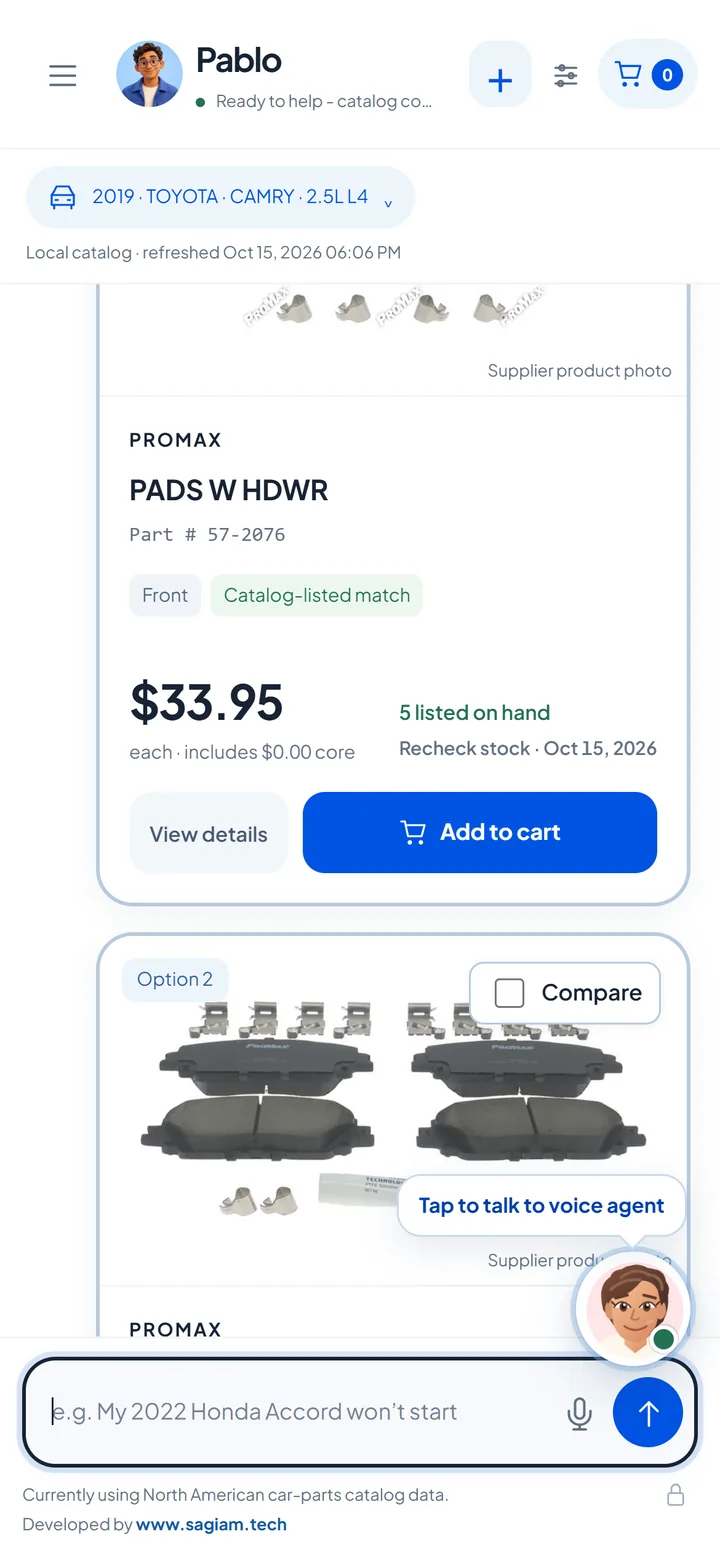
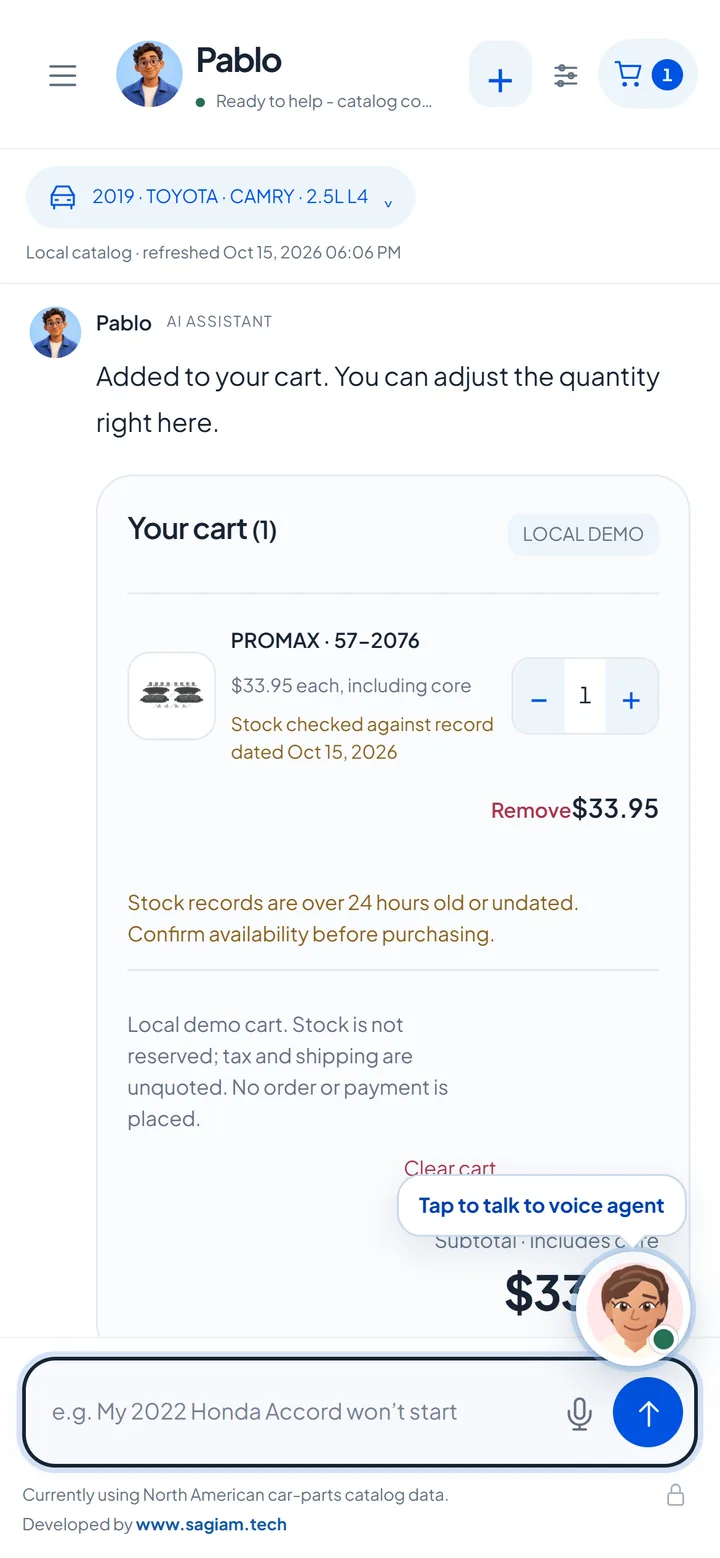
Suggestions come with the selected store's price and quantity, so customers aren't sold something the store can't hand over.
When someone buys pads, Pablo can offer matching rotors and hardware for the same vehicle. A good counter person does exactly that.
Anything uncertain, safety-related or outside the catalogue is passed to a person, with the conversation attached so nobody starts again.
| Situation | Today | With Pablo |
|---|---|---|
| Customer calls at 9 pm | Voicemail. They try another store. | Pablo answers, finds the part and holds it in a cart. |
| "My car is making a noise" | Customer guesses from a long search list. | Pablo asks the right questions and narrows it to parts that fit. |
| Busy Saturday at the counter | Phone keeps ringing with fitment questions. | Repeat questions are handled online; staff serve the people in front of them. |
| Customer buys brake pads | Leaves without rotors or hardware. | Matching parts for the same vehicle are offered at the right moment. |
| Store moving online | Catalogue is online but hard to search. | Customers shop the catalogue the way they talk. |
Growing with it
Pablo sits on top of the catalogue and stock data you already maintain, so the same assistant can grow as the business does.
Each store has its own stock and pricing. Customers choose their store once and every answer reflects it.
The same assistant can run on your website, inside a mobile app, on a kiosk at the counter or, with phone integration, on an incoming call line.
As new brands and categories enter the catalogue, Pablo can use them as soon as the product and fitment data are approved.
Built to be trusted
Parts advice can affect safety and money. We designed Pablo to be careful before it is clever.
Part of a bigger picture
Pablo can only be as accurate as the data behind it. We also build the catalogue, fitment data and online store that make it possible, as we did for ProStock Auto.
Screens show Pablo running on sample vehicles against North American catalogue data. Stock, prices and cart in these screenshots are from a demonstration environment; no real order or payment was placed. Results in a live store depend on the quality of its catalogue, fitment and stock data.
Run a parts store or distribution business?
Show us your data and how customers buy from you today. We'll tell you honestly what an assistant like Pablo could handle, and what it needs first.